
[ORIGINAL EN CATALÀ] [TRADUCCIÓN AL ESPAÑOL]
PROTOCOL: DISPUTATIONS IN THE SHADE
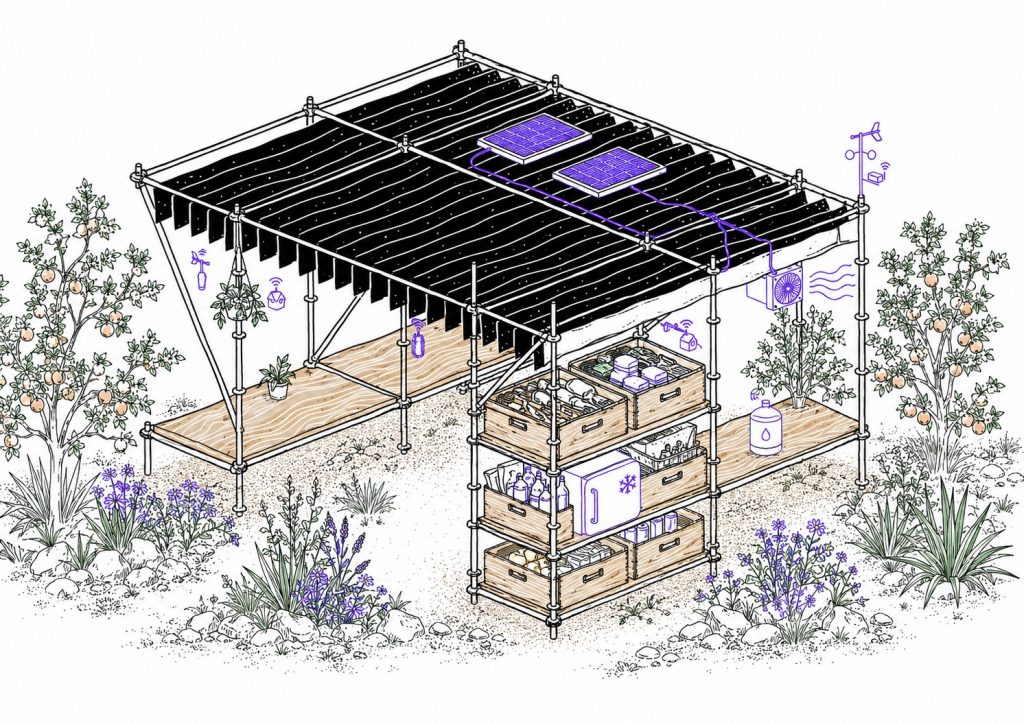
In our itinerant spatial activations, the Department of Umbrology aims to establish protective shades to map, describe, and contest territorial grievances (demographic shifts; thermal comfort, accessibility, and the right to green spaces; housing conditions; opacity and surveillance, etc.) through ephemeral interventions intended for public visibility, awareness, and the socio-ecological protection of contested sites.
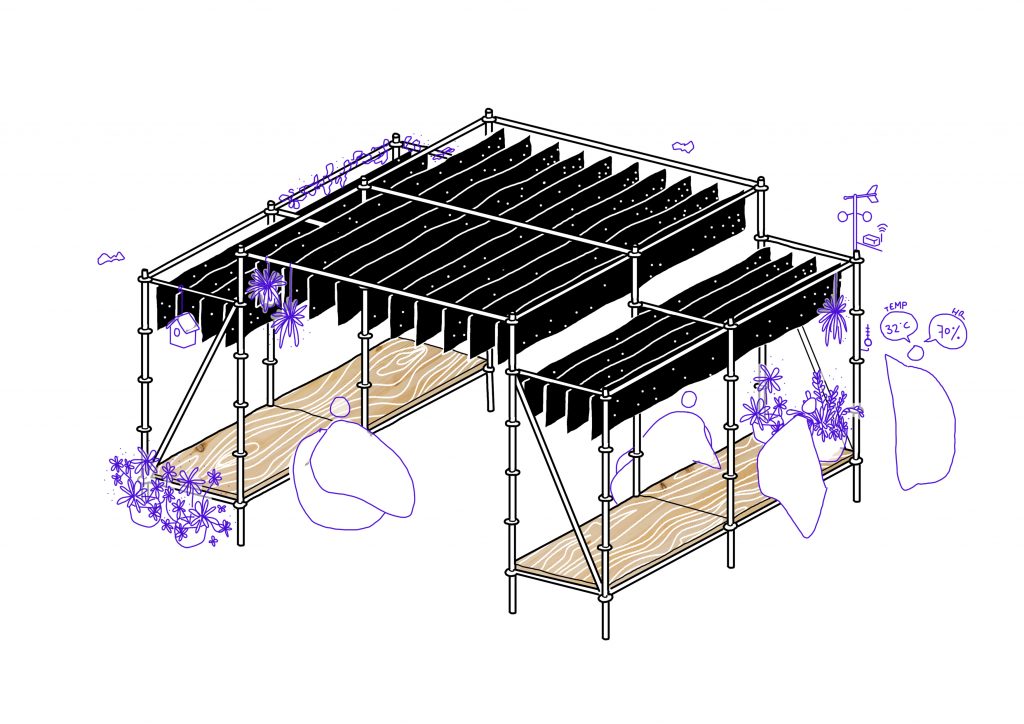
We seek to temporarily occupy these shaded areas not only as sites of fleeting protection, but as true urban parliaments: nomadic architectures designed to accommodate diverse living beings and their respective concerns; spaces to deliberate upon our right to shade, driving toward climate sovereignty and grassroots self-protection protocols.
Consequently, we call for the shading of public spaces to serve as democratic platforms, where shadows accommodate a plurality of urban definitions for the city’s various living beings: that is, as spaces for multispecies relations intended to suspend the solar order of traditional urban planning. We designate these activities as disputations in the shade.
It is our intent that these disputations—drawing inspiration from the Parlement de Loire and its continuation in the internationale des rivières et autres éléments de la nature, or the Court for Intergenerational Climate Crimes—act as vehicles for a popular inventive statecraft or, in other words, serve the public imagination in responding to the urban challenges of the ongoing climatic mutation.
In these disputations in the shade, we would like to create a space for listening to umbrological grievances —fostering the expression of the problems of solar urbanism experienced by a diversity of bodies— and, in response, open for public comment the following draft of an Urban Right to Shade Ordinance (DRETUMB), conceived as an instrument to reclaim our right as holobionts to devise new forms of self-protection, transcending the solar regime of currently instituted urbanism.
We welcome all submissions to dispute, enrich, expand, specify, amend, and adopt this text as your own!
PUBLIC CALL FOR COMMENT: URBAN RIGHT TO SHADE ORDINANCE (DRETUMB)
(Version 1.0, Summer 2026 – This is a true and accurate translation of the original ordinance drafted in Catalan. For all legal purposes, the Catalan original text shall be consulted as the sole authentic and official version)
PREAMBLE
WHEREAS, human industrial activity has established a new climatic regime marked by an intensification of solar radiation and urban heat island effects that directly threaten the core habitability of our habitats;
WHEREAS, modern urban design—reliant on hard infrastructure, reflective surfaces, and materials with high thermal inertia—operates as a vector for socio-ecological displacement;
WHEREAS, habitability is not an exclusive attribute of human beings, but rather of the interconnected web of life, which must be defended as a fundamental political condition;
NOW, THEREFORE, BE IT ORDAINED that this Ordinance shall stand as a regulatory framework protecting urban habitability, understood as a right of holobionts to remain within an urban territory without atmospheric conditions nullifying their biological viability, in all their uniqueness: respecting the plurality of ways in which the habitability of each living being manifests, while establishing the necessary diplomatic mechanisms to resolve potential frictions or conflicting interests within multispecies relations.
Shade is hereby defined as a dynamic common good: a nomadic atmospheric flow resulting from the interception of solar radiation, constituting the minimal and essential infrastructure required to maintain the city within a habitable thermal threshold.
Inspired by the Habitability Principle outlined by Baptiste Morizot and Laurent Neyret, the theses on Ecological Redirection by the Origens Medialab, the explorations of political biotic communities within the Zoöp Model, and the urban climate policy guidelines Decoding Comfort, the Department of Umbrology hereby proclaims the seasonal right to urban shade and vindicates penumbra and opacity (as conceptualized by Édouard Glissant) as a climate shelter for holobionts. Accordingly, pursuant to its Guide: The City of Shades, urban shade is established as a fundamental protection for all living bodies, ensuring they are not left fully exposed and vulnerable to solar irradiation.
To this end, shade is guaranteed as an architecture of popular climate sovereignty, enabling the self-protection of holobionts and the continuity of life in times of climatic mutation, as well as the exploration of new forms of urban habitability.
TITLE I: FOUNDATIONS AND SUBJECTS OF THE RIGHT
- Section 1. Definition of Shade: Shade is recognized as a dynamic common good. It constitutes, concurrently, the guarantee of a Right to Opacity: the right of every holobiont not to be rendered fully transparent, measurable, or monitored by the structures of urban thermopower. Shade is the sanctuary of non-translatable uniqueness.
- Section 2. The Holobiont as a Subject of Law: This Ordinance extends protection to biotic communities (defined as not only humans but the web of relationships between microbiomes, fauna, and flora, alongside the abiotic elements critical to their survival), recognizing that their habitability depends upon access to thermal refuge and solar concealment.
TITLE II: URBAN REST
- Section 3. Rest Zones: During periods of radiant heat alerts and extreme weather, all shaded areas shall be legally recognized as Rest Zones. This designation shall entail the following:
- 3.1. The right to the communal use of private porches, awnings, and building eaves is hereby encouraged and supported.
- 3.2. An Umbrological Hospitality Easement (UHE) is hereby established across all public rights-of-way. The UHE imposes a legal obligation upon any structure, wall, or built element (whether publicly or privately owned) to cede the use of the shade it casts upon the ground or adjacent space for the shelter of holobionts. This easement shall be automatic, free of charge, and non-negotiable during hours of high solar irradiation. Recognizing the dynamic properties of this atmospheric flow, the easement shall not attach to a fixed geographic coordinate, but shall shift continuously with the projection of the shadow footprint throughout the day.
- Section 4. The Right to Rest in Public Space: Any municipal bans, ordinances, or regulations restricting or prohibiting resting in public spaces are hereby suspended within shaded areas. Horizontal rest is recognized as a physiological survival necessity for holobionts. The City shall not compel continuous movement or urban circulation under conditions of acute thermal stress.
TITLE III: SOLAR PROTECTION INFRASTRUCTURES
- Section 5. Solar Protection Factor (SPF): The City, as a unified entity, shall actively contribute to the SPF of every neighborhood:
- 5.1. Buildings shall incorporate eaves, awnings, and pergolas or, failing that, guarantee their temporary deployment. Mirrored or highly reflective glass facades that project solar radiation and invasive glare into common rest spaces are strictly prohibited.
- 5.2. Umbrophilic Continuity Guarantee (UCG): The City shall guarantee an uninterrupted network of shade across all public spaces, achieved through green or artificial infrastructures with all necessary structural overlaps. No holobiont shall be compelled to endure direct, unshaded solar exposure for a duration exceeding 5 minutes to complete any essential urban commute.
- 5.3. Seasonal Adaptation: Traffic signals, pedestrian crossings, and other urban signage systems shall be calibrated to minimize the solar exposure time of living beings. The mapping and signage of alternative climate itineraries shall be mandatory.
- 5.4. Every neighborhood shall guarantee that 50% of its ground surface is kept cool and permeable. Shaded areas must allow bodies to rest in direct contact with the earth or with materials featuring low thermal inertia that do not disrupt the thermoregulation of holobionts.
- 5.5. Due consideration shall be given to the heat capacity, thermal conductivity, and effusivity (heat transfer rate) of materials; consequently, the use of organic materials (wood, textiles, unpaved earth) that do not retain burning temperatures shall be prioritized in public spaces over concrete, metal, glass, and stone.
- 5.6. Given the interplay between thermal and chromatic factors (light colours reflect radiation but cause visual blindness/glare; dark colours absorb and subsequently emit high heat), urban planning authorities are directed to integrate color mechanics into public space design.
- Section 6. Shadow Tax:
- 6.1. Any form of hoarding, enclosure, or privatization of shaded spaces—irrespective of public or private title—as well as their appropriation for commercial or exclusionary purposes (including, but not limited to, outdoor dining terraces, restricted institutional enclosures, or infrastructures that impede, limit, or condition free public access to climate self-protection) shall be immediately subject to taxation as follows:
- 6.1.1. A shadow tax equivalent to 15% of the monthly gross turnover generated by any economic activity operating within the footprint of said shadow projection, applicable to commercial establishments.
- 6.1.2. A shadow tax assessed at €500 per square meter of enclosed or restricted shaded area, payable monthly, applicable to buildings, facilities, or premises of an institutional or public nature.
- 6.2. All revenues derived from this tax shall be transferred directly to the Neighborhood Umbrological Assemblies (ASUB) of the affected district, pursuant to Title V of this Ordinance. The ASUB shall hold exclusive jurisdiction over the management, allocation, and auditing of these funds to finance local projects of subtractive urbanism and urban ecological redirection.
- 6.1. Any form of hoarding, enclosure, or privatization of shaded spaces—irrespective of public or private title—as well as their appropriation for commercial or exclusionary purposes (including, but not limited to, outdoor dining terraces, restricted institutional enclosures, or infrastructures that impede, limit, or condition free public access to climate self-protection) shall be immediately subject to taxation as follows:
TITLE IV: CLIMATE SELF-PROTECTION AND TEMPORARY OCCUPATION OF SPACE
- Section 7. Right to Midday Truce: During the peak hours of the day throughout the summer months, the city shall transition into a slow metabolic state. Shaded areas shall be respected as shelters for shared rest and penumbra. All municipal or commercial activities that disrupt such refuge are suspended.
- Section 8. Self-Protection and Transitory Space Occupation License:
- 8.1. A universal, standing permit is hereby granted to install emergency umbrological infrastructures, exempt from aesthetic censorship or formal municipal application processes. The climate self-protection of holobionts shall take legal precedence over the visual or architectural branding of the city, as well as any decorative, monumental or heritage preservation criteria. Traffic and pedestrian safety conflicts shall be adjudicated on an individual basis.
- 8.2. Holobionts retain the right to move their bodies and personal property in alignment with moving shadows, and may occupy any public space that provides thermal refuge. The right to remain unobserved and free from data collection or tracking within shaded areas is guaranteed.
- Section 9. Right to Work Suspension: The suspension of any outdoor labour or work activity under direct sunlight is authorized whenever access to adequate shade cannot be guaranteed, without penalty, loss of wages, or disciplinary retaliation.
TITLE V: FUTURE DEPLOYMENT OF AN URBAN ECOLOGICAL REDIRECTION PLAN
- Section 10. Public Participation and Ecological Redirection Process: To ensure the systematic ecological redirection of municipal infrastructure—conceived not as an abrupt abandonment or a clean slate strategy, but as the politicized, deliberate, and managed phase-out of modern solar urbanism—the City shall establish Neighborhood Umbrological Assemblies (ASUB) as co-decision, design, and governance bodies for infrastructure withdrawal. These ASUBs shall serve as the competent deliberative authorities to determine which infrastructures, technical systems, or urban utilities tied to the solar regime shall be dismantled, subjecting the fate of the city’s obsolete or climate-harmful assets to public dispute.
- 10.1. Composition of Neighborhood Umbrological Assemblies (ASUB): The regulatory procedure for the functioning, election, and structure of the assemblies within the territory is detailed below:
- 10.1.1. Convocation of Annual Assemblies: The governance of the ecological redirection of each ASUB shall emanate directly from an open annual assembly, configured as the sovereign organ of direct democracy and community decision-making. For it to take place, a public convocation shall mandatory be issued through all official channels at least one (1) month in advance, clearly setting the location, date, and time of the meeting. Furthermore, the Department of Umbrology must be formally notified with the same one (1) month notice so that it may be present at the event and exercise its functions as an external guarantor of the integrity of the process. Every person present shall have the right to vote in this assembly, as well as those representatives or proxies delegated by human collectives or non-human entities (fauna, flora, microbiomes, or surrounding ecosystems) who cannot physically attend.
- 10.1.2. Constitution of the ASUB Coordination Committee: Within this annual assembly, each ASUB shall constitute, through direct election, a coordination committee composed of thirteen (13) members—established as an odd number to facilitate the unlocking of any tie in decision-making. It shall be structured under a strict sectoral quota comprising: two (2) representatives from the municipal public administration; two (2) from the scientific and academic sector under a criterion of epistemic parity (at least one from the humanities and social sciences, and at least one from the natural sciences with a profile that transversally encompasses human and non-human health); two (2) from the architecture, urbanism, and landscaping sector focused on climate mitigation; one (1) from the cultural sector and critical artistic practices; and six (6) representatives from the territory’s associational and neighborhood movement, explicitly guaranteeing within the latter the presence of patient collectives, individuals with conditions of solar medical vulnerability, and those chronically affected by sun exposure or thermal stress.
- 10.1.3. Duration and Accountability: The elected coordination committee shall hold full executive autonomy to manage the day-to-day affairs of each ASUB, the exercise of which shall be submitted annually to the public judgment of the open assembly. In this annual oversight session, the committee is obligated to publicly render accounts of the ecological redirection procedure by publicly defending: the identification and certification of Thermal Sacrifice Zones (see 10.2), the updating of the catalog of urban negative commons (see 10.3), and the debate on proposals for the transformation of solar infrastructure. The mandate of the individuals elected to this committee shall have a maximum duration of three (3) years, non-renewable consecutively to ensure rotation. The annual assembly shall also serve to specifically replace those positions that have become prematurely vacant. The Department of Umbrology shall validate the receipt of funds from the Shadow Tax (Article 6) and shall periodically audit the expenditure process to certify its exclusive implementation in the city’s ecological redirection.
- 10.1.4. Contingency Procedure: In the event of a manifest dispute, institutional deadlock, or irreversible lack of consensus that prevents the ordinary celebration or the election of the thirteen (13) member committee of an ASUB, a Temporary Emergency Assembly shall be constituted ex officio. It shall have a non-extendable duration of one (1) year under the supervision and guarantor arbitration of the Department of Umbrology. This transitional structure shall function as a reduced contingency organ to ensure that the territory is never left unprotected or without shadow governance. It shall be integrated by a minimum of one (1) single member from each of the five sectors mentioned in article 10.1.2 (municipal administration, scientific, architecture/urbanism, cultural, and neighborhood), thereby guaranteeing the continuity of the basic custody of the territory until the next convocation.
- 10.2. The Assemblies shall map existing Thermal Sacrifice Zones (TSZ) to initiate their democratic dismantling. This subtractive urbanism shall be executed through gradual withdrawal protocols (depaving, dismantling polluting utility flows, planting urban forestry and greenery, or executing insurgent irrigation networks) specifically designed to monitor, mitigate, and repair any metabolic, socio-economic, or supply chain disruptions that the infrastructure’s deactivation might impose on the local community.
- 10.3. The ASUBs shall further be charged with identifying and managing the urban negative commons that emerge during their assessments.
- 10.3.1. Negative commons are defined as the remnants of fossil-fuel urbanism, environmental liabilities, persistent toxicities, structural heat islands, obsolete infrastructures of the modern solar regime, or hostile architecture fixtures installed to exclude living beings from shaded areas. Far from dissolving upon closure or dismantling, these entities persist within the territory as inherited material burdens. Given their irreversible or long-lasting nature, they cannot be treated as mere waste to be eliminated or externalized, but must be managed as hazardous realities requiring long-term collective responsibility, care, and public governance by the community.
- 10.3.2. The democratic dismantling process shall formally acknowledge these burdens, which shall be placed under a regime of institutional co-responsibility and popular custody. The ASUBs, in coordination with the Department of Umbrology, shall draft the necessary containment, remediation, and community surveillance protocols to govern the metabolic impacts of these negative commons during and after their deactivation.
- 10.1. Composition of Neighborhood Umbrological Assemblies (ASUB): The regulatory procedure for the functioning, election, and structure of the assemblies within the territory is detailed below:
- Section 11. Interspecies Decision-Making Framework: The ASUBs shall convene the various living entities of a given locality and shall prioritize consensus-based decision-making. In the event of a deadlock, a voting procedure may be invoked. The votes of holobionts demonstrating the highest thermal vulnerability shall be assigned preferential weight. Multispecies inquiry protocols shall be established utilizing delegated representatives tasked with safeguarding the rights and interests of the collective biotic community (adhering to the Zoöp Model).
- Section 12. Biotic Recycling Protocol: All structural materials salvaged from dismantling operations must be repurposed locally to create micro-habitats providing shade, humidity, and opacity for microfauna and spontaneous urban flora.
FINAL PROVISIONS
First. Validity and Technical Activation Criteria. This ordinance shall automatically enter into force whenever the following technical conditions are met:
- Institutional Activation (preferential route): Immediately and ex officio whenever the competent authorities formally declare any level of heat alert, with the declaration of a yellow alert / Level 1 or higher, the Ministry of Health’s National Plan for Preventive Actions Against the Effects of Excess Temperatures on Health, or the Generalitat de Catalunya’s Operational Plan to Prevent the Effects of Heat on Health (POCS) being sufficient reference.
- Transitional Popular Activation (emergency route): In the absence of a formal institutional alert, the ordinance shall be considered fully in force and enforceable at the neighborhood level whenever the combination of air temperature and relative humidity registers a Heat Index of “caution” or higher. For the popular, immediate, and free verification of this activation in public space, any person may use a portable thermometer-hygrometer and cross-reference the local readings with the IS Global Heat Index calculator.
- Methodological Justification: It is explicitly stated that, despite being the scientific reference standard for evaluating thermal stress risk in the field of occupational risk prevention (NTP 1189 / WBGT Index), the WBGT index (wet-bulb globe temperature) is discarded as an activation method for this ordinance. Its measurement complexity, the need for specialized instrumentation, and the time required to obtain data render it completely inoperative for the daily, immediate, and unrestricted management of the right to shade by citizens.
- Additional Territorial Diagnosis Criteria: For the correct future deployment of the planning, subtractive urbanism, and removal governance functions attributed to the Neighborhood Umbrological Assemblies (ASUB) in Title V of this norm, it is strictly recommended to incorporate and review structural vulnerability indicators, such as the Climate Change Vulnerability Index (IVAC) of the Barcelona Metropolitan Area (AMB). These indicators can serve as a reference methodological matrix for the objective identification of Thermal Sacrifice Zones (TSZ) and the management of urban negative commons.
- Jurisprudence Clause of Singular Bodies: It is explicitly recognized that the activation thresholds and indicators defined in this provision are human-centric in nature and are adopted exclusively as an initial operational reference for the emergent deployment phase of the norm. Given that urban habitability protects the entirety of the biotic community, it is recognized that not all bodies are equal before the urban climate and that not all bodies that this Ordinance aims to protect are human. Therefore, the ASUBs and the Department of Umbrology shall compile data from the first applications of the ordinance in order to generate a climate jurisprudence based on the singularity of each body and multi-species justice. This practice will allow for the gradual reconfiguration and adaptation of the ordinance’s activation thresholds, both to the distinct vulnerabilities of the human sphere and to the survival and comfort needs of different living beings (fauna, flora, and microbiomes).
Second. Sanctioning Regime and Oversight. Non-compliance with this ordinance shall be considered Biotic Negligence and Violation of Opacity, prosecutable ex officio by the Department of Umbrology. The Department of Umbrology shall be the organ responsible for overseeing, collecting, and managing the financial assets derived from the Shadow Tax regulated in Article 6. These funds must be transferred directly, transparently, and without bureaucratic intermediation to the respective treasuries of the Neighborhood Umbrological Assemblies (ASUB) of the territory where the tax was generated (see Title V), being exclusively earmarked for the financing and deployment of their local urban ecological redirection plans.